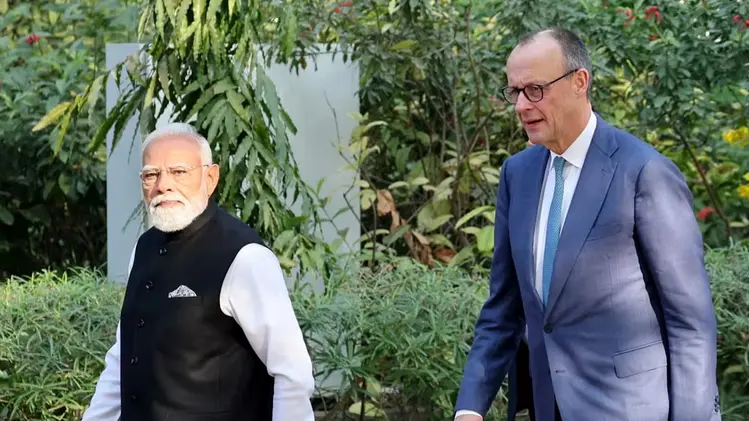
German Chancellor Friedrich Merz floated the possibility that the European Union and India could sign a free trade agreement as early as the end of this month, after he met Indian Prime Minister Narendra Modi on Monday.
The presidents of the European Commission and European Council would travel to India at the end of January to sign the agreement if it is finalized by then, Merz said on his visit to the western Indian city of Ahmedabad.
Speaking on Monday during a trip to India, German Chancellor Friedrich Merz said European Commission President Ursula von der Leyen and European Council President Antonio Costa could sign a free trade agreement with New Delhi by the end of the month.
Germany India Deal Likely by End of January After Intensive Talks
Negotiations had previously been expected to conclude by the end of this year. However, according to German government sources, there are high expectations that a deal could be signed at the end of January after “very intensive” talks between Merz and Modi.
Indian Trade Minister Piyush Goyal, speaking at a separate event in the western state of Gujarat, said an agreement was almost at its final stages.
Merz said the world is experiencing “a renaissance of unfortunate protectionism” that harms Germany and India. He did not name any countries.
US Pressures India With Tariffs Over Russian Energy Imports
The United States has been pressuring India with tariffs to end its purchases of Russian oil and gas, which Washington and the European Union argue is used to fund the war in Ukraine.
Chinese Export Controls Disrupt Supply Chains, Hitting German Carmakers
Chinese export controls on minerals used in industries such as autos caused months of supply chain disruption last year due to the U.S.-China trade war, affecting German carmakers.
Beijing also imposed restrictions on some semiconductors widely used in the car industry after the Dutch government’s decision to seize control of Chinese-owned chipmaker Nexperia.
For the EU, signing a deal with India would follow the bloc’s green light on Friday for concluding a pact with South America’s Mercosur group. It would mark another step in building its own trade networks as the United States shakes up global commerce, while helping reduce reliance on China.
Germany Seeks Closer Security Ties With India to Reduce Reliance on Russia
In particular, Germany wants to work more closely on security issues with India to reduce India’s reliance on Russia, Merz said.
The countries signed a memorandum of understanding to that effect, in addition to agreements on critical minerals, the health sector and an artificial intelligence innovation center.
India still works closely with Russia on security policy, and much of its military equipment is made in Russia. It is also one of the largest buyers of Russian gas and oil alongside China.
EU Trade Agenda Fuels Turmoil in France
Last week, India’s Minister of Commerce and Industry Piyush Goyal travelled to Brussels for further high-level negotiations with EU trade chief Maroš Šefčovič, who last year described Indian negotiators as “tough”.
Both India and the EU are facing escalating trade problems with the US, which has raised tariffs on its trade partners, and China, which is increasingly attempting to weaponise other countries’ dependencies on raw materials and technology.
Merz nonetheless said he was confident the talks have entered their final stretch, remarking that the signing of the deal would be “an encouraging sign on the path to continue down the road of forging and concluding free trade agreements”.