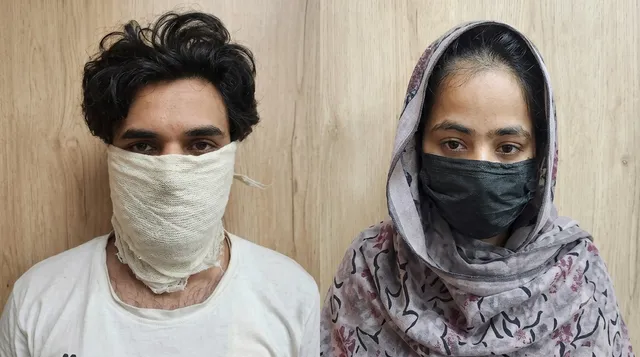
Delhi Police have arrested a couple accused of spying for Pakistan’s Inter Services Intelligence (ISI), who were allegedly using Indian SIM cards to gather sensitive military information.
The Delhi Police have uncovered a network involved in spying for Pakistan’s intelligence agency, ISI. Police have arrested a couple from Sarai Kale Khan who had allegedly been working for ISI backed Pakistan Intelligence Operatives (PIOs) since 2024.
According to the Delhi Police, the arrested suspects have been identified as Mohammad Sahil, originally from Budaun, and his wife, Sameera.
Large Scale Supply of Indian SIM Cards
The Delhi Police investigation has revealed that large quantities of Indian SIM cards were being supplied to entities backed by Pakistan’s intelligence agency, ISI. These SIM cards were primarily used to activate WhatsApp accounts and carry out espionage-related activities against India.
Meanwhile, recent cases have revealed that these SIM cards were sent to Pakistan via Dubai, enabling handlers based there to infiltrate WhatsApp groups using Indian numbers and gather sensitive military and security related information.
The Couple Had Been Assigned this Task
The arrested couple had been tasked with recruiting people to conduct reconnaissance of military cantonment areas in India. Sahil was also assigned the task of providing information about army personnel whose court martial proceedings were pending before tribunals. Earlier this week, the police had also arrested a Pakistani spy named Pradipta Basu from the Hauz Rani area.
According to Special Cell Deputy Commissioner Nara Chaitanya, while gathering information about terrorist organizations and their overground workers and sleeper cells providing them support, the team received information about a PIO network operating in the National Capital Region (NCR).
Delhi Police Uncover Pakistan Linked Spy Network Using Indian SIM Cards and Encrypted Communication
The investigation has revealed that this module had recruited local people in Delhi into its network to gather military information and obtained Indian SIM cards through them. Handlers based in Pakistan were using WhatsApp accounts activated with these Indian numbers to collect sensitive defense-related information.
Police recovered two mobile phones from the accused, Sameera, which contained incriminating chats with Pakistani operatives. The operation also revealed how handlers based in Pakistan maintained contact with overground workers through encrypted communication platforms.
Sent 8 SIM Cards to Pakistan, Received ₹30,000 in Return
Interrogation revealed that Sahil and Sameera were friends in 2024 and came into contact with a Pakistani agent through Instagram during that period. The two later got married, after which the Pakistani agent introduced them to a Pakistan Intelligence Operative (PIO).
Sahil and Sameera sent eight Indian SIM cards to Pakistan via Dubai in 2024 and 2025, for which they received ₹30,000 in return. In Pakistan, WhatsApp accounts were activated using these numbers, allowing Pakistani operatives to join several Indian groups and contact Indian citizens to gather sensitive information.
New Spying Tactics Raise Alarm Among Security Agencies
Rapid changes in the methods of espionage are emerging as a new challenge for security agencies. It is no longer necessary for spies to visit sensitive areas and establish direct contact.
Making friends with someone from the comfort of home through social media and gradually bringing them under one’s influence can also be part of an espionage network.
According to sources familiar with the investigation, conversations in such cases initially appear completely normal. The other person may seek to deepen contact under the pretext of friendship, employment, financial assistance, or a shared interest. After establishing trust through conversations over a period of time, they may gradually make requests related to sensitive information or activities.
Pakistani Handlers Allegedly Used Indian Numbers to Infiltrate WhatsApp Groups, Probe Finds
Following the couple’s arrest, the investigation revealed that Pakistani handlers had attempted to gain access to certain Indian WhatsApp groups using these Indian mobile numbers. The network’s alleged objective was to build contacts with members of these groups and obtain information shared within them.
Because the numbers appeared to be Indian, the person on the other end had no reason to suspect that the individual chatting with them might actually be based in Pakistan. In this way, the mobile numbers effectively became a kind of “gateway” for the network.
Sameera Worked at a Call Center in Noida
The arrested individual, Sahil, was born in 2001. After completing his B.A. from IGNOU, he began working with a lawyer while planning to pursue an LL.B. He left the job in June last year and has been unemployed ever since.
His father, Mohammad Asfaq, moved to Delhi from his hometown of Badaun in 1982 and settled in Sarai Kale Khan, where he works as a car mechanic. Sameera was born in 2005. After completing her Class 12 education in Delhi, she pursued a B.A. through correspondence.
Before her arrest, she worked at a call center in Noida. Her father, Nadeem, moved to Delhi from his hometown of Bijnor in 1996 and settled in Shakurpur. He supplies cold drinks and bottled water to local markets in Shakurpur.
Verifying Digital Identities has Become a Challenge
The biggest challenge for security agencies is determining whether the identities being used on social media are genuine. Using fake names, photographs, and profiles, someone can maintain contact with an individual for a long period of time.
As the conversation progresses, evidence related to mobile phones, messaging apps, and digital transactions becomes an important part of the investigation.
From the perspective of investigating agencies, even a photograph of a sensitive location, information about movement, or seemingly routine details related to an official or institution can be significant. This is why digital forensics is now playing a crucial role in the investigation of espionage cases.