A new report by Aspire For Her and Shaadi.org reveals a sobering reality: marriage and motherhood remain the leading reasons why millions of Indian women are forced to leave the workforce, with only a fraction ever returning. Despite rising education levels and aspirations, entrenched social norms and systemic barriers continue to lock women out of economic participation, costing India dearly in lost talent and productivity.
National Crisis: The Numbers Behind the Exodus
-
50% of working mothers in India quit their jobs by age 30, with marriage and motherhood as the primary triggers.
-
Only 27% of women who take a career break ever return to work, highlighting a massive loss of female talent.
-
~7 million women are actively seeking to return to the workforce right now.
-
India ranks 131 out of 148 countries on the Global Gender Gap Index (2025), placing it among the bottom five for economic participation.
-
129:1 — the ratio of applications per seat in a leading returnship program, underscoring the pent-up demand for re-entry opportunities.
“This report puts numbers to what we see every day: the life event around which most women’s careers quietly pause.” – AFH x Shaadi.org “The Great Indian Return” Report, 2026
State-by-State: Where the Exodus Is Most Acute
While the crisis is national, its intensity varies sharply across states. Data from the Periodic Labour Force Survey (PLFS) 2022-23 and 2023-24, combined with secondary analyses, reveal stark contrasts:
|
State/Region |
Female LFPR (2022-23) |
Marriage/Domestic Duty Exit Rate |
Notable Trends |
|---|---|---|---|
|
Bihar |
Lowest |
Highest |
Traditional norms, high marriage/domestic exits |
|
Uttar Pradesh |
Low |
Very High |
Rural married women most affected |
|
Rajasthan |
Low |
Very High |
Gender roles drive exits |
|
Punjab, Haryana |
Low |
High |
Among lowest LFPR, high marriage/domestic exits |
|
Madhya Pradesh |
Below Avg. |
High |
Marriage a major exit factor |
|
West Bengal |
Moderate |
High |
Marriage/domestic duties lead exits |
|
Kerala |
High |
Low |
Progressive norms, better retention |
|
Tamil Nadu |
High |
Low |
Education, policies reduce marriage exits |
|
Himachal Pradesh |
High |
Low |
Urban women marry later, stay in workforce longer |
-
National Female LFPR: 37% (2022-23), up from 25% in 2017-18.
-
43.04% of women nationally cite household duties as the main reason for not working.
Are Indian Women Marrying Later? The Marriage Age Shift
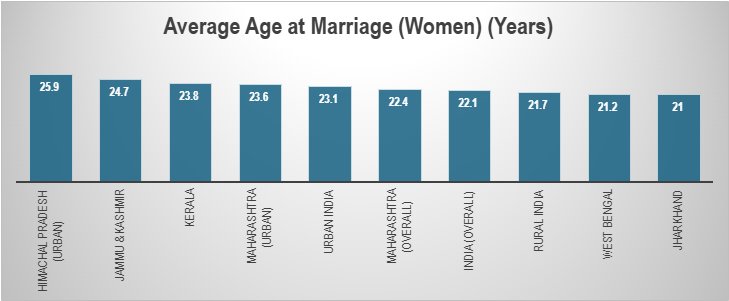
The average age at first marriage for Indian women is rising, reflecting gradual social change:
|
State/Region |
Average Age at Marriage (Women) |
|---|---|
|
Himachal Pradesh (urban) |
25.9 years |
|
Jammu & Kashmir |
24.7 years |
|
Kerala |
23.8 years |
|
Maharashtra (urban) |
23.6 years |
|
Maharashtra (overall) |
22.4 years |
|
West Bengal |
21.2 years |
|
Jharkhand |
21.0 years |
|
India (overall) |
22.1 years |
|
Urban India |
23.1 years |
|
Rural India |
21.7 years |
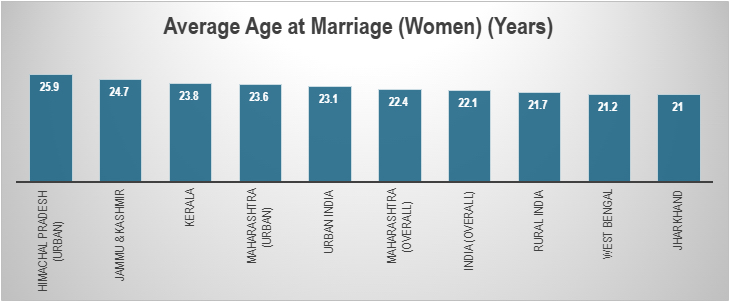 |
Average age of women at marriage (years)
-
Trend: The national average age at marriage has increased from 18.7 years in 1991 to 22.1 years today.
-
Urban women are marrying later than rural women, with the highest ages in Himachal Pradesh and Jammu & Kashmir.
The Barriers: Why Women Don’t Return
Despite rising aspirations, women face formidable obstacles to workforce re-entry:
-
Hiring Penalty: Women with a career break face a 24 percentage point lower chance of being hired than men with similar qualifications.
-
Marriage Reduces Participation: Marriage alone reduces women’s labour force participation by 12 percentage points; childbirth by a further 4 points.
-
Attrition After Marriage: 13% of employed women leave their jobs after marriage.
-
Childcare & Flexibility: Lack of reliable childcare and flexible work options are major deterrents.
-
Mobility Restrictions: Many women become “trailing spouses,” relocating for their husband’s career and losing their own job prospects.
-
Social Stigma: Persistent cultural expectations push women to prioritize family over career.
-
Maternity Penalty: Women face lower pay, missed promotions, and stigma after maternity leave.
Key Finding:
Marriage and motherhood remain the dominant reasons for women’s workforce exit in India, especially in states with traditional gender norms. While the average age at marriage is rising, systemic barriers — from employer bias to lack of childcare — continue to lock millions of women out of economic opportunity.
Call to Action
Through The Great Indian Pause Report, we aim to spotlight the barriers that force millions of women out of the workforce and build momentum for solutions that enable their return. The Great Indian Pause forms part of the #HerIndependence campaign by Aspire For Her and Shaadi.org, an initiative dedicated to advancing women’s economic independence and workforce participation. Aspire For Her and Shaadi.org urge employers, policymakers, and families to:
-
Create structured returnship programs to help women re-enter the workforce.
-
Promote flexible work and childcare support to retain female talent.
-
Challenge social norms and stigma around women’s careers and career breaks.
-
Enforce pay parity and anti-discrimination policies for women returning after marriage or motherhood.
“The Great Indian Pause can become the Great Indian Return — if we open the door.”