Donald Trump’s policies are not going to make America great again, but they have certainly pushed the world toward becoming multipolar. The way India and Europe are drawing closer may not completely eliminate America’s importance in this region, but it will definitely reduce it.
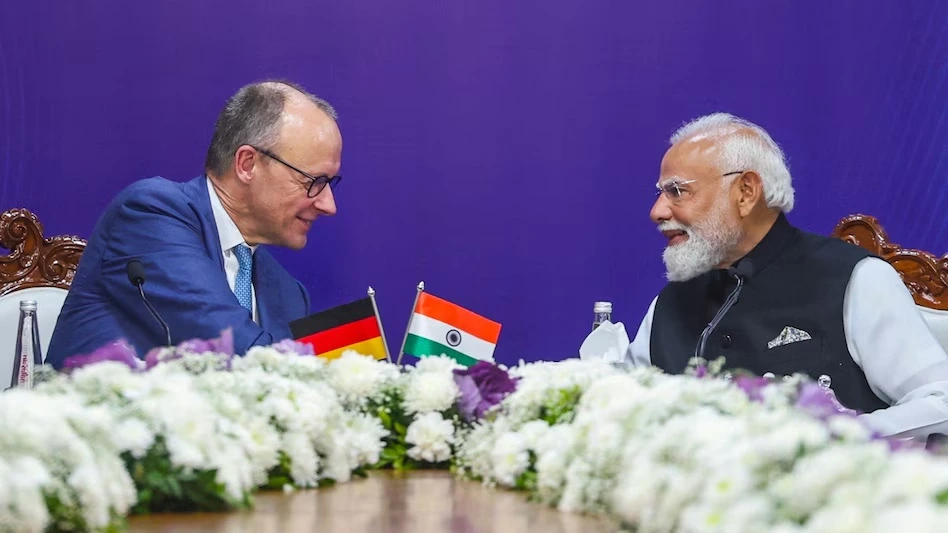
A strong rapport was seen between German Chancellor Friedrich Merz and Prime Minister Narendra Modi on January 12, 2026, during the Kite Festival in Ahmedabad. The kind of agreements being signed between the two countries suggest that this is an attempt to send a direct and strong strategic message to US President Donald Trump.
Notably, it is not just India but the entire world that is concerned about the impact of Trump’s short-sighted policies. In this context, Europe too is working on a strategy to move out of the American web. Just a few days ago, India signed several agreements with the UK and France.
India has also finalized an FTA deal with the UK. Various defense deals are being concluded between India and Germany. Perhaps this is the first time that Germany is entering into deals of this level with a non-NATO country.
India and Germany’s Strategic Partnership Amid U.S. Protectionism
The Trump administration imposed tariffs of up to 50% on India in 2025. It also passed a bill stating that if any country does not stop buying Russian oil, the US president can impose tariffs of up to 500%. On the other hand, Trump has repeatedly threatened to seize Greenland. In such a situation, India’s deep defense, technological, and economic cooperation with Germany challenges Trump’s unilateral world order. It shows that India and Europe will no longer remain dependent on the United States; instead, they are strengthening themselves with alternative partners Germany and Europe.
German Chancellor Merz’s First Asia Visit
German Chancellor Merz, who took office in May 2025, is on his first Asia visit and this is his first bilateral trip outside NATO/EU. He arrived in Ahmedabad on January 12, where Modi welcomed him. Both visited the Sabarmati Ashram, participated in the International Kite Festival, and then held a bilateral meeting.
It is understood that several MoUs are being signed, with the most significant deal in the defense sector. A submarine deal worth approximately ₹70,000 crore is moving ahead rapidly. Germany’s ThyssenKrupp Marine Systems (TKMS) and India’s Mazagon Dock Shipbuilders (MDL) will jointly build six advanced AIP-equipped stealth submarines (Project-75I) in India.
This will involve full technology transfer, which is the first time India is receiving such a large-scale transfer from a European country. This is India’s largest defense agreement to date. The deal will strengthen India’s Navy in the Indo-Pacific and help address threats from China and Pakistan.
Along with this, MoUs on semiconductors and critical minerals could give a boost to India’s chip and battery industries. Agreements on migration and worker mobility are also expected, which will make it easier to recruit skilled Indian workers in Germany. Additionally, regarding the EU-India FTA, Merz said that the deal could be finalized by the end of January.
FTA With EU Will Be A Game Changer
Germany is playing a key role in rapidly advancing the EU-India FTA (Free Trade Agreement between India and the European Union). This agreement will involve all 27 EU member countries, with Germany as a major participant, so it will also apply to Germany.
Germany believes that an India-EU FTA is necessary to unlock the full potential of India-Germany economic relations. The German President described India as a ‘desired partner’ and a ‘partner of choice.’ German Ambassador Philipp Ackermann said before the visit that German businesses consider the FTA a game-changer, and the Chancellor will emphasize it.
Germany is India’s largest trade partner in the EU. The FTA will reduce tariffs and increase exports. After Trump’s tariffs, India is looking more toward the EU.
Direct Reply to Trump
We generally know Germany as the country that played a key role in the formation of NATO. But today, the entire Europe, including Germany, is concerned. It is believed that the US is planning to use NATO to attempt a takeover of Greenland. Perhaps Europe currently sees India as the only reliable partner who can help reduce dependence on Russia. At the same time, India and Europe together have the potential to replace the US and China in trade.
India continued to buy S-400 systems and oil from Russia, which Trump does not like. That is why the deal with Germany is a reply to Trump. India is now expanding defense partnerships not just with the US, but also with Germany, France (Rafale, Scorpene), and Israel. At the same time, the EU FTA and trade with Germany will increase, reducing the impact of Trump’s tariffs. India will not yield unilaterally. Despite Trump’s threats, India’s partnerships remain strong.
Trump was tough on Cuba and Iran, but Europe is also not happy with pressure on democratic countries like India. This is why India and Europe have come closer. The visit to Germany shows Trump that India is bringing diversity to its global partnerships.
Benefits for India
6 AIP submarines could increase India’s dominance in the Indian Ocean. Technology transfer can give a boost to Make in India. Germany is already a major trade partner for India (over $50 billion in 2025), and the FTA will increase this further.
Along with this, it will create a kind of strategic balance in global trade. Trump’s ‘America First’ policy forced India to look toward Europe. Similarly, Europe now wants to move out of US influence. The Modi-Merz deal is a direct reply to this. India will no longer depend on a single country. This is a victory for multi-alignment.