Imagine you wake up in a horizontal development in Goa, somewhere around February. Sunlight emerges through the existing canopies of trees and reaches your window. You get on your slippers, navigate through the living room, cross your veranda, and there you are, breathing fresh air.
Alternatively, think of living in a vertical apartment whose foundation was done by clearing the land or reshaping the ecology of the overall region.
Now, out of the two, the latter might be advanced or leveraged by tech integrations, but the philosophy is dominating nature’s format rather than leveraging it. Opulence in luxury real estate in 2026 is all about building thoughtfully with nature, rather than building large.
Why Responsible Architecture Matters More Than Ever
A random luxury development is no longer making it easily to an investor’s portfolio. Buyers, particularly HNIs and NRIs, are more aware of- how a property would present its ecological impact, climate sensitivity, and permanence.
Post-pandemic, the international wellness real estate market was valued at $13 billion in 2024, as against $6 billion in 2019. Even a recent ANAROCK survey has revealed this growing shift in buyer psychology. It states how 70% of the buyer community are rooting for good construction materials, open spaces (dedicated balconies), and wellness integration.
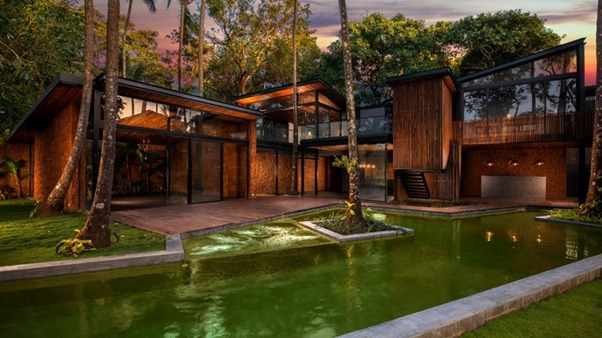
Think of your villa, emerging along the contours of palm trees, its interiors crafted out of locally sourced materials, and its seriousness in cross-ventilation and natural light. That is the kind of richness and luxury that the elite seek these days.
Going Beyond Traditional Construction
The ideology of traditional developments has evolved from maximizing built density or treating land as a blank canvas to something that is being built around existing nature. Luxury buyers are appreciating assets that allow a 100-year-old patch of green zone to thrive, letting the trees and water bodies paint their surroundings.
People these days want to live around a home that encourages green living, leveraged by shaded pathways and ample ventilation notes. Subsequently, water features and the incorporation of locally sourced materials help them feel connected to nature.
How Goa Aligns with This Design Philosophy
The state’s tropical climate, filled with dense green foliage and a slow culture, favours this wellness-driven living philosophy to the core. HNIs are counting on second homes where they expect to get away from all the city’s bustle.
If you particularly look at North Goa’s development landscape, you’ll find villas that help one breathe properly, enjoy seamless indoor-outdoor accessibility, and have corners planned for the owner’s lifestyle needs.
All these elements indicate the rooted nature of Goa’s developments, rather than an imposed one.
Responsible Development as Legacy Builder
When a home is strategically built around an existing ecological landscape, it feels as if it is naturally connected to its surroundings. Thoughtful design elements like green foliage as acoustic intelligence, teakwood, and laterite as the interiors, giving a warm tone matter. These are not just highlights of a sustainable property but a testament to legacy building. And masterpieces of this sort are deliberately scarce, driving their worth.
Buyers have started valuing responsible developments on the basis of well-being and economic soundness. Keeping their story intact within these abodes, they appreciate that it also preserves value for the generations to come.
The Human Angle of Responsible Living
Boutique developers these days are first investing in understanding the site. Then they calculate how it can be intended towards the human-nature connection. A true curator of biophilic residences today ensures that every tree is intact, even after the project is completed. The result leads to a soothing experience for the residents, where every corner is crafted with meaning and every lush landscape encourages healthier routines.
From considering natural light allowance to free flow of air and seamless transition from private spaces to public amenities, everything feels thoughtful in luxury villas. These are what help one grow professionally and personally.
Anokha Estates: Crafting within Existing Ecology
Amidst this growing urge of buyers to shift towards mindful and wellness living, we consider that we are at the epicentre of it. Right from our establishment in Goa, back in 2018, our philosophy remained the same- to build intentionally around trees to transform lives. Even if you look at our Villa in the Palms project, it respects the site’s local environment, preserving all 19 coconut trees.
The buyer of tomorrow is investing not just for their well-being and growth, but also for their family’s future. The ones with second homes are setting an example of how a premium experience adds value.
Final Blend of Nature
Beyond 2026, the luxury real estate market will count on biophilic villas to lead the next generation. Responsible development is on the rise, where architectures are built around trees, rather than dominating them. Overall, this shift in real estate trends, particularly in coastal regions like Goa, highlights how luxury living can thrive while respecting the ecology and culture of the landscape.
A genuine future-ready home might not be the most transformative in landscape, but the ones that learn from it.