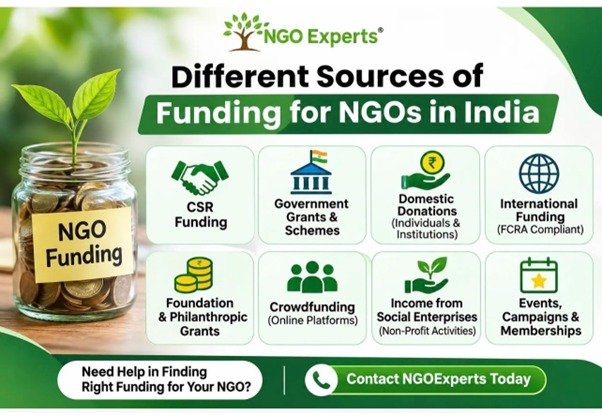
The six primary means of funding for NGOs in India are individual retail donations, corporate social responsibility (CSR) grants, central and state government schemes, foreign contributions, private family foundations, and self-generated earned income. To access them legally, Indian non-profits require baseline Section 12A and 80G tax registrations, a NITI Aayog Darpan ID for government funds, Form CSR-1 for corporate grants, and FCRA approval for overseas money.
Running an NGO requires more than a meaningful mission. Whether you work in education, healthcare, rural development, women’s empowerment, or environmental conservation, securing consistent funding is essential to sustaining your programs and expanding your impact.
Yet many NGO founders struggle to identify the right funding opportunities, meet donor eligibility requirements, and navigate the registrations needed to receive institutional grants.
The solution is to build a diversified fundraising strategy rather than depend on a single donor or funding program.
This guide explains the six major sources of NGO funding in India, the registrations required to access them, and practical ways to build a financially sustainable non-profit organisation.
What Are the Different Sources of Funding for NGOs in India?
The six major sources of funding for NGOs in India are individual donations, corporate CSR grants, government funding schemes, domestic philanthropic foundations, foreign contributions, and earned income. NGOs can combine these funding channels based on their legal status, operational experience, program objectives, and regulatory eligibility.
A diversified funding model helps organisations reduce financial uncertainty and maintain long-term program continuity.
1. Individual Donations and Crowd Funding
Individual donations are among the most accessible funding sources for newly established NGOs. Contributions can come from individuals, community members, philanthropists, alumni networks, and online supporters.
NGOs can raise funds through:
- Direct bank transfers and UPI contributions.
- Monthly and recurring donation programmes.
- Fundraising campaigns and community events.
- Online crowdfunding platforms such as GiveIndia, Milaap and Ketto.
- Corporate employee-giving and individual sponsorship initiatives.
Registrations and requirements: An NGO should have valid legal registration, PAN, appropriate income-tax registration and an organisational bank account. Eligible organisations seeking to offer tax deductions to donors must obtain the applicable donation-related approval under the Income-tax Act, 2025.
How to attract individual donors: Build credibility through transparent financial reporting, beneficiary stories, measurable programme outcomes and regular updates on how donations are utilised.
For recurring support, create specific giving options such as sponsoring a child’s education, supporting healthcare services or funding community development activities.
2. Corporate Social Responsibility (CSR) Funding
Corporate Social Responsibility funding is one of the largest institutional funding opportunities available to eligible NGOs in India.
Under Section 135 of the Companies Act, 2013, qualifying companies are required to spend at least 2% of their average net profits from the preceding three financial years on eligible CSR activities.
According to the Bharat CSR Performance Report 2026, India’s CSR expenditure reached approximately ₹40,794 crore in FY 2024–25, highlighting the scale of corporate funding available for social development.
CSR projects commonly support:
- Education and skill development.
- Healthcare, sanitation and nutrition.
- Women’s empowerment and gender equality.
- Environmental sustainability.
- Rural development and livelihood enhancement.
- Poverty alleviation and social welfare.
Eligibility and registrations: Eligible implementing agencies generally need to be constituted as a Section 8 company, registered public trust or registered society, as applicable under the CSR Rules. Relevant entities must hold the required income-tax registrations and file Form CSR-1 to obtain a CSR Registration Number.
For independent implementing agencies under the relevant CSR Rules category, an established track record of at least three years in similar activities is required. Other specified categories have separate eligibility provisions.
How to secure CSR funding: Identify companies whose CSR priorities align with your NGO’s activities. Prepare a structured project proposal covering the target beneficiaries, implementation locations, project budget, measurable outcomes, monitoring framework and utilisation reporting.
CSR funding should be approached as a long-term implementation partnership, not simply a request for financial assistance.
3. Central and State Government Grants
Government grants provide financial assistance to NGOs working in priority development sectors. These funds are distributed through central ministries, state departments, government agencies and scheme-specific programmes.
Depending on the scheme, funding may support:
- Child welfare and women’s development.
- Rural livelihoods and skill development.
- Education and vocational training.
- Healthcare and community welfare.
- Disability support and rehabilitation.
- Environmental conservation and rural development.
Eligibility and registrations: Requirements differ across government schemes. NGOs may need valid legal registration, PAN, applicable tax approvals, audited financial statements, programme experience and a NITI Aayog NGO Darpan Unique ID.
A Darpan ID is required under relevant government grant processes, but applicants should always verify the specific scheme guidelines rather than assume that identical conditions apply to every ministry.
How to apply: Monitor official ministry and state government notifications, check eligibility conditions, prepare the prescribed application documents, and submit a project proposal within the specified deadline.
Government funding can offer opportunities to scale established programmes, but NGOs should plan for detailed documentation, financial audits, utilisation certificates and scheme-specific monitoring.
4. Domestic Philanthropic Foundations and Private Trusts
Domestic philanthropic foundations are another important funding source for NGOs in India. These organisations support social impact programmes through grants, partnerships, fellowships and institutional development initiatives.
Examples include:
- Tata Trusts.
- Azim Premji Foundation.
- Rohini Nilekani Philanthropies.
- Other private charitable trusts and corporate-backed philanthropic foundations.
Funding priorities may include education, public health, environmental sustainability, livelihoods, community development and social equity.
Eligibility and requirements: Each foundation follows its own grantmaking criteria. Common requirements include legal registration, applicable tax approvals, audited financial statements, governance documents, a clearly defined project proposal and evidence of program outcomes.
Some foundations support established organisations, while others offer opportunities to emerging NGOs and grassroots initiatives.
How to secure foundation grants: Research the foundation’s funding priorities before applying. Demonstrate how your programme addresses a clearly defined social problem, explain the expected outcomes and provide a realistic budget with measurable indicators.
Strong program documentation and transparent governance can improve an NGO’s credibility with institutional donors.
5. Foreign Contributions and International Grants
Foreign contributions can help Indian NGOs access international philanthropic funding, overseas foundations, development organisations and global donor networks.
However, receiving foreign contributions is regulated under the Foreign Contribution (Regulation) Act, 2010 (FCRA), as amended. NGOs must obtain the appropriate FCRA registration or prior permission before accepting foreign contributions.
There are two principal routes:
FCRA Registration: Generally intended for organisations with at least three years of existence and a demonstrable record of charitable activities, subject to the applicable eligibility and financial requirements.
FCRA Prior Permission: An alternative route for an eligible organisation seeking to receive a specified foreign contribution from a particular donor for a defined project.
Important compliance requirements include:
- Receiving foreign contributions through the designated FCRA account at the State Bank of India’s New Delhi Main Branch.
- Maintaining separate accounts and records for foreign contributions.
- Using funds only for permitted purposes.
- Filing the prescribed annual returns.
- Complying with the applicable administrative expenditure limit, generally 20% of foreign contributions, unless prior approval is obtained for exceeding it.
An NGO should never accept foreign contributions into an ordinary domestic donation account without first confirming its FCRA eligibility and approval status.
6. Earned Income and Social Enterprise Revenue
NGOs can also generate income through activities connected with their charitable objectives. Earned income can provide greater financial flexibility and reduce dependence on external grants.
Common examples include:
- Vocational training and educational workshops.
- Research, consultancy and capacity-building services.
- Publications and educational resources.
- Membership fees and programme-related contributions.
- Sale of products created through beneficiary livelihood programmes.
However, income generating activities must comply with the applicable charitable-purpose and tax-exemption provisions. The activity must satisfy the relevant legal conditions, including restrictions on commercial activity and maintenance of separate books of account where required.
An NGO cannot automatically claim tax exemption simply because it reinvests its business profits into social activities.
Practical approach: Develop revenue generating activities that complement your charitable objectives, maintain transparent financial records and obtain professional tax advice before expanding commercial operations.
Why Should NGOs Diversify Their Funding Sources?
Depending entirely on one donor or funding programme can expose an NGO to financial instability. A delayed CSR instalment, an unsuccessful grant application or a change in donor priorities can interrupt essential programmes.
A diversified funding strategy helps NGOs:
- Maintain regular programme operations.
- Reduce dependence on individual donors or corporate sponsors.
- Build stronger financial reserves.
- Reach new donor networks.
- Improve institutional credibility.
- Plan long-term expansion with greater financial confidence.
For example, a newly established education NGO could begin with individual donations and community fundraising, apply for suitable domestic foundation grants, and gradually prepare for CSR partnerships as its governance and operational track record develop.
The objective is not to pursue every funding opportunity. It is to identify funding sources that align with the organization’s mission, capacity, and compliance status.
Comparison of Major NGO Funding Sources in India
| Funding Source | Suitable For | Key Requirements |
| Individual donations | New and established NGOs | Legal registration, PAN, donation compliance and applicable tax approval |
| Crowdfunding | NGOs with strong public campaigns | Platform verification, organisational documents and transparent reporting |
| CSR grants | NGOs implementing corporate-aligned projects | Eligible legal entity, applicable tax registrations and CSR-1 |
| Government grants | NGOs working in priority government sectors | Scheme-specific eligibility, documentation and Darpan ID where required |
| Domestic foundations | NGOs with defined social-impact programmes | Grant-specific eligibility, governance records and financial statements |
| Foreign contributions | NGOs seeking international funding | FCRA registration or prior permission |
| Earned income | NGOs with sustainable programme-related activities | Compliance with charitable objects and applicable tax rules |
Note: These are indicative requirements, not universal eligibility conditions. Actual requirements depend on the funding programme, legal structure and applicable regulations.
Essential Registrations and Documents for NGO Funding in India
Before approaching donors, NGOs should establish a reliable compliance and documentation framework.
The following registrations and records are particularly important:
- Legal Registration: Establish the organisation as a Public Charitable Trust, Registered Society or Section 8 Company, depending on its objectives and governance requirements.
- PAN and Bank Account: Obtain the organisation’s PAN and maintain a dedicated bank account in its legal name.
- Income-Tax Registration and Donation Approval: Secure the applicable registration under Section 332 and approval under Section 354 of the Income-tax Act, 2025. Existing valid registrations under the Income-tax Act, 1961, continue subject to the transition provisions.
- NITI Aayog NGO Darpan ID: Obtain a unique ID where required for relevant government grant applications.
- CSR-1 Registration: File Form CSR-1 where the organisation qualifies as an eligible CSR implementing agency.
- FCRA Registration or Prior Permission: Obtain the appropriate approval before receiving foreign contributions.
- Financial and Governance Records: Maintain audited financial statements, annual returns, governing-body details, activity reports, project budgets, donor records and utilisation certificates as applicable.
Important 2026 tax update: From 1 April 2026, new applications under the Income-tax Act, 2025, use the revised framework. Form 104 is used for relevant provisional registration or approval applications, while Form 105 is used for regular registration or approval applications. The corresponding approvals are issued in Forms 106 and 107, respectively.
For eligible organisations reporting donations, the new framework also introduces Forms 113 and 114. Legacy Forms 10A, 10AB, 10BD and 10BE may remain relevant for earlier applications or reporting periods under the transition provisions. NGOs should confirm the applicable form for their particular tax year.
Common NGO Fundraising Mistakes to Avoid
Even organisations with strong programmes can lose funding opportunities because of avoidable compliance and planning mistakes.
1. Accepting Foreign Donations Without FCRA Approval
Foreign contributions must not be accepted without the required FCRA registration or prior permission. Contributions from eligible Indian citizens living abroad from their personal savings through normal banking channels are treated differently under FCRA. Verify the donor’s status and source of funds before accepting a contribution.
2. Ignoring Tax Registration Renewals
Provisional and regular tax registrations have different validity periods and application requirements. Monitor approval validity and file the applicable renewal or regular-registration application within the prescribed timeline.
3. Failing to Maintain Donation Records
Eligible organisations must follow applicable donor-reporting and certificate-issuing requirements. Under the new Income-tax Act framework, Forms 113 and 114 are relevant to donation reporting and certificates, while legacy requirements may apply to earlier periods.
4. Submitting Weak CSR Proposals
A compelling social mission alone is not enough. CSR teams expect clear project objectives, realistic budgets, measurable outcomes, implementation capacity and transparent reporting.
5. Depending on a Single Funding Source
An organisation that depends entirely on one corporate donor or government grant can face serious operational challenges when funding is delayed or discontinued. Build a funding pipeline across suitable domestic and institutional sources.
Frequently Asked Questions About NGO Funding in India
The main funding sources include individual donations, crowdfunding, CSR grants, central and state government schemes, domestic philanthropic foundations, foreign contributions and earned income from programme-related activities.
Yes. Newly registered NGOs can raise eligible domestic individual donations and explore suitable crowdfunding opportunities and foundation grants, subject to applicable requirements. Direct CSR funding and government grants depend on the eligibility criteria of the respective funding programme.
No. These approvals are not universal prerequisites for every form of domestic fundraising. However, the applicable income-tax registration and donation approval are important for charitable tax benefits and are required for specified CSR implementing-agency categories. Under the Income-tax Act, 2025, the corresponding provisions are sections 332 and 354.
Certain eligible entities established by a company or government, or established under legislation, may qualify under separate categories. However, independent implementing agencies generally need an established track record of at least three years in similar activities, along with the other applicable conditions.
No. NGO Darpan registration is required for relevant government schemes and funding processes where specified. It is not a universal legal requirement for every NGO or every funding source.
An NGO must obtain FCRA registration or project-specific prior permission before accepting foreign contributions. Receiving foreign money without the required approval can result in serious regulatory consequences.
Yes, subject to applicable charitable-purpose and tax provisions. Income-generating activities must satisfy the relevant legal conditions, and organisations must maintain appropriate accounts and ensure that their activities remain compliant with their approved objectives.
There is no universally best structure. Public Charitable Trusts, Registered Societies and Section 8 Companies can all access funding opportunities if they satisfy the relevant eligibility requirements. A Section 8 Company may be suitable for organisations seeking structured corporate governance and institutional partnerships, while trusts and societies may suit other operational models.
Build a Funding-Ready NGO with the Right Compliance Strategy
Accessing funding is not just about finding donors. It is about building an organisation that funders can trust.
From selecting the right legal structure and securing tax registrations to obtaining CSR-1, maintaining financial records and preparing grant proposals, every compliance decision influences your organisation’s fundraising readiness.
NGOExperts supports non-profit organisations with NGO registration, tax registrations, CSR-1 assistance, statutory compliance and funding-readiness advisory services.
Whether you are establishing a new NGO or preparing an existing organisation to approach institutional donors, the right compliance roadmap can help you pursue suitable funding opportunities with greater confidence.